First Light Avery Lake
12 sec / silent / loop
Avery Lake First Light; or, Transient Smartphone Blindness, 2026
Single-channel video / silent / 12 seconds / 1 of 1
Minted upon request
01
The Work After a breath of darkness, a blinding rectangle ignites. The eye spends twelve seconds learning to tolerate it.
One 1/1
Moving image
2026

You know this moment. It is dark, you have just woken, and you reach for the phone. The screen ignites at a brightness your eyes are not ready for, and for a few seconds you are blinded by the first light of your day.

First Light performs that moment once. A rectangle of light, too bright to look at, floods the darkness with glare. Then the eye adapts: the glare settles, the halo tightens, the bloom resolves, and the rectangle becomes something the body can tolerate. Faint pattern seems to gather inside the white, and never resolves. Nothing is ever readable. The work is the eye learning to receive the day.

The phone never appears. What is shown is not a device but a perception: light arriving in the body faster than the body can receive it.

TitleFirst Light; or, Transient Smartphone Blindness
ArtistAvery Lake
Year2026
MediumSingle-channel digital video, silent
Format1080 × 1350 px, 4:5, 12 seconds, 24 fps
EditionUnique work, 1 of 1, minted upon request
DiptychMorning work: received light / residual light
Conceptual fieldPerception, glare, adaptation, the Intelligence Age
02
Artist Statement The first sunrise of the day is no longer the sun. It is an interface.
Perception
Glare
Adaptation

I make work about the media we live inside without noticing, the way we live inside weather.

For most of human history, the first light of the day was the sun: light the eye evolved to wake into. Now, for many of us, the day begins with a rectangle at a brightness the dark-adapted eye cannot yet hold. The pupils are wide, the retina is running at full sensitivity, and the screen arrives like noon. We squint, we look away, we look back. We do this every morning, and we have stopped noticing that the day now begins with a small act of violence against our own vision.

The phenomenon is real enough to have entered the medical literature: ophthalmologists have described patients temporarily blinded in one eye after checking a phone in the dark, a condition given the name transient smartphone blindness.

This work does not dramatize any of that. It simply performs it: ignition, glare, and the slow, patient competence of the eye. The subject is not the screen. The subject is the body, still trying to meet the light on its own terms.

03
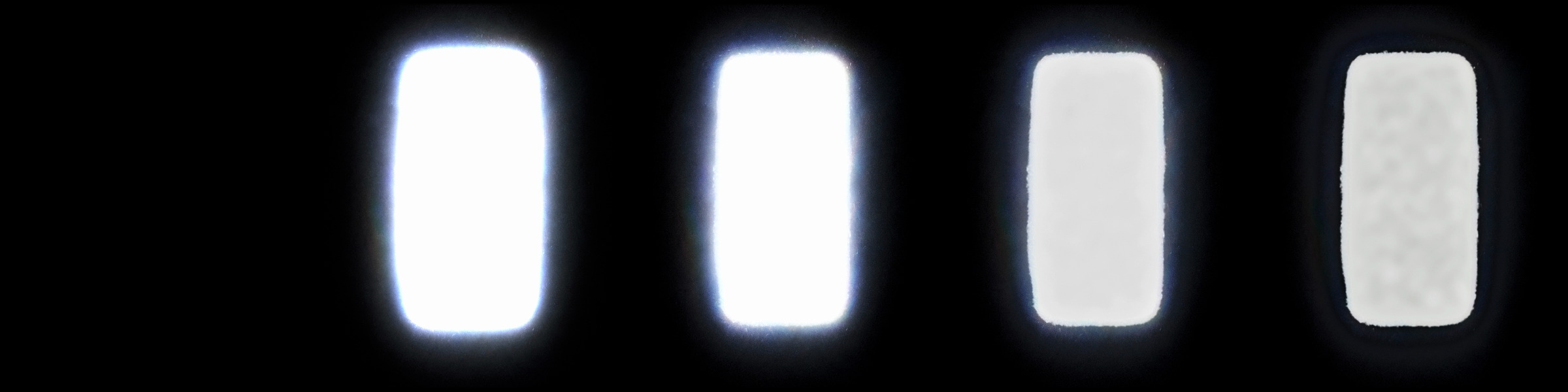
Material Sequence Five states of one adaptation: darkness, ignition, glare, containment, tolerance.
Twelve seconds
Five states
White

The work begins with eight frames of absolute black. After ignition, the adaptation is strictly continuous: the glare only settles; it never pulses, never re-brightens. The steep relief comes first and the fine adjustment last, the way dark-adapted vision actually recovers.

Five stills from First Light by Avery Lake, showing a blinding white rectangle settling into a contained, tolerable light.
First Light, five states of adaptation / 0 s, 0.33 s, 3 s, 6 s, 12 s
  • 01 DarknessThe room before the screen. The eye is still fully dark-adapted.
  • 02 IgnitionThe screen arrives before the eye is ready. Glare floods outward.
  • 03 GlareThe rectangle is present but cannot be looked at.
  • 04 ContainmentThe light pulls back inside its own edges.
  • 05 ToleranceA calm white rectangle, holding an almost-pattern that never resolves. The day has begun.
04
Lineage The morning work of a diptych: received light, residual light.
Diptych
Parent field
Perception

First Light is the morning work in a two-part cycle with Residual Light; or, Cellphone Afterimage. In the morning, screen light enters the body faster than the body can receive it. At night, screen light remains in the body after the device is gone. Received light. Residual light.

The two works are exact formal siblings: twelve seconds each, the same locked frame, the same absent phone, one irreversible movement. First Light settles. Residual Light disappears. Together they bracket one day and one exchange between body and machine.

The diptych sits inside the larger field of Signatures Through Technologies, moving between Code & Screen, Prompt & Machine, Light & Mirror, and Luminescence & Matter. In this practice every dominant medium eventually becomes a mirror. Across the diptych, the mirror wakes you and remains after you close your eyes.

05
Technical Provenance The work is presented as a fixed moving-image master, preserved with its companion materials.
Master
Archive
Certificate

The work is presented as a fixed moving-image master. Its companion materials, the ignition still and the five-state adaptation sequence, are preserved in the studio archive and transfer with the work.

  • Concept and artworkAvery Lake
  • MasterSingle-channel digital video, 1080 × 1350 px, 12 seconds, silent, fixed, eight-frame blackout before ignition
  • CertificateArtist-signed certificate accompanies acquisition; a machine-readable record is published at artwork-metadata.json
06

Acquire

First Light; or, Transient Smartphone Blindness is available as a unique 1/1 digital artwork. It can be certified and minted upon request when there is a collector, institution, or specific reason to place it on chain. The work transfers with the moving-image master, the ignition still, the five-state adaptation sequence, and an artist-signed certificate. It may be acquired singly or with Residual Light as the complete diptych. No public sale price is currently listed.

Inquire